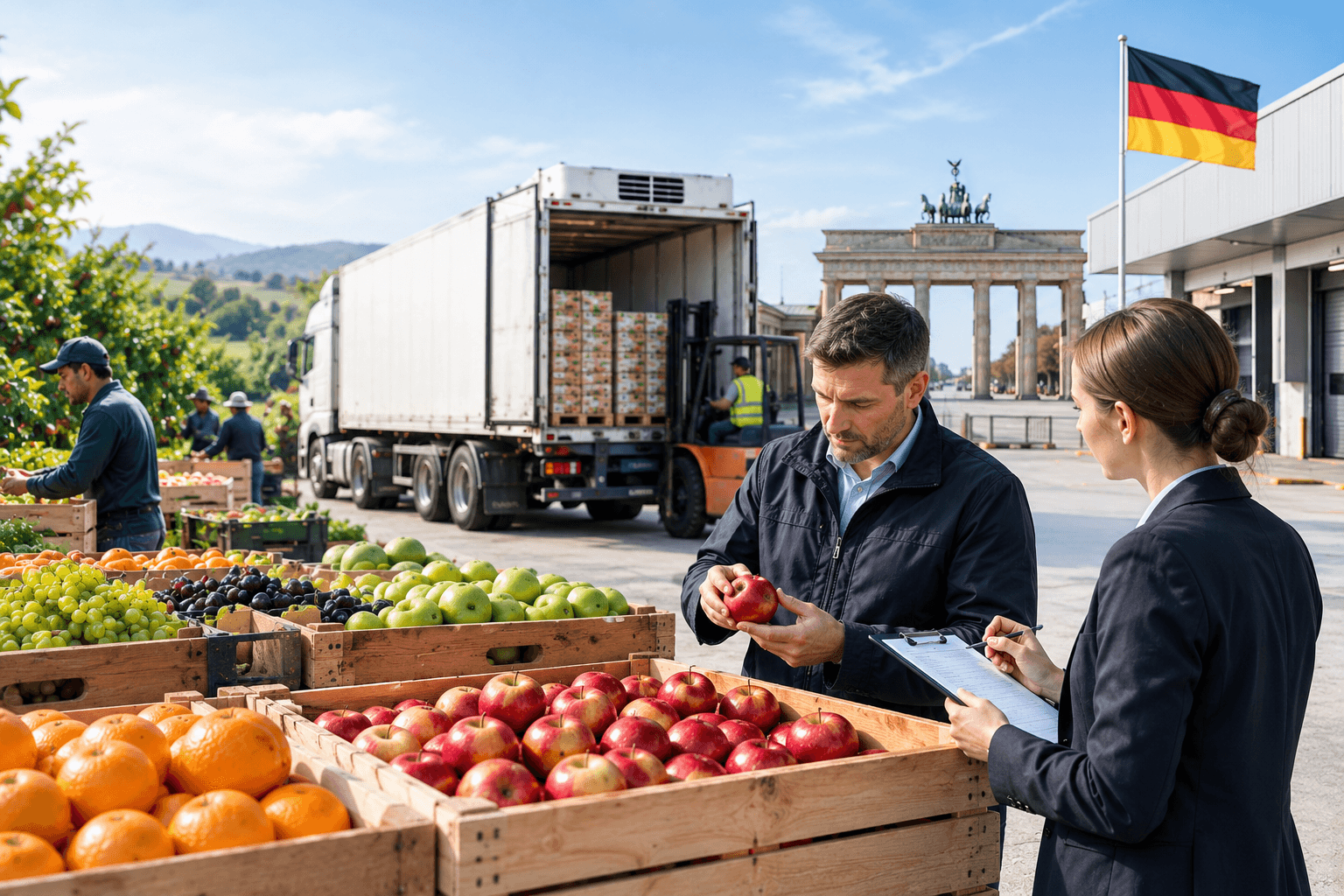
Fresh fruit importers in Germany secure their supply chains by matching strict residue limit testing at origin with precise pre-arrival documentation and routing refrigerated containers through Northern European ports. Success relies on logging certificates in the TRACES NT portal, standardising packing formats for European warehouses, and calculating accurate inland freight costs to regional distribution hubs.
How do fresh fruit importers in Germany route incoming shipments?
Importers route the vast majority of their maritime volume through major Northern European ports like Rotterdam, Antwerp, or Hamburg before moving the containers inland to Germany. This approach provides established fiscal clearance channels and dedicated temperature-controlled logistics infrastructure. The choice of port dictates the maritime transit time and determines the subsequent road haulage required to reach either regional wholesale distribution hubs or the central warehouses of large retail chains.
Mapping direct retail procurement against wholesale hubs
The supply structure you build depends entirely on your delivery volumes and buyer relationships. Direct retail procurement suits importers supplying major supermarket groups, which demand continuous, high-volume container deliveries directly to their regional distribution centres. Alternatively, supplying wholesale hubs in cities like Hamburg, Munich, and Berlin provides the flexibility needed to serve regional food service providers and fresh fruit and veg wholesalers who take smaller daily allocations from standard import volumes.
| Product | 2021 German import volume |
|---|---|
| Total fresh fruit | 5,450,000 MT |
| Fresh bananas | 1,415,000 MT |
| Fresh apples | 606,000 MT |
Customs data published by the USDA Foreign Agricultural Service shows bananas accounted for more than a quarter of the total fresh fruit volume in 2021, making them a cornerstone for importers structuring high-volume shipping lines, while apples represent a substantial but highly seasonal import requirement.
What documents does the TRACES NT portal require for clearance?
You must lodge pre-notification documents and request export certificates through the Trade Control and Expert System New Technology (TRACES NT) online portal. The European Union requires this procedure to clear German borders smoothly, a rule reported by the Government of British Columbia. Furthermore, fresh fruits and vegetables must be accompanied by a phytosanitary certificate issued by the competent authority of the exporting country, a European Union requirement reported by the USDA Foreign Agricultural Service. Without these pre-notifications logged before the vessel arrives, border control will hold the containers, leading to immediate demurrage charges and lost shelf life.
Commissioning accredited residue testing before loading
Fresh fruit and vegetables for the German market must comply with European Union legal food safety requirements for plant protection and post-harvest treatment limits. This European Union rule is reported by the Centre for the Promotion of Imports from developing countries (CBI). Importers must provide residue analyses carried out by accredited laboratories to prove products do not exceed maximum residue levels, a requirement of the Federal Office of Consumer Protection and Food Safety. Because German retail buyers frequently enforce their own limits that sit well below standard European legal caps, securing this testing at origin prevents costly rejections upon arrival.
How to calculate landed cost fresh produce for the German market?
Calculating an accurate landed cost requires adding the inland haulage from your chosen Northern European port of discharge to the initial CIF or CFR price. An origin price only covers the freight to the destination port, meaning the true cost to the buyer must account for terminal handling charges, fiscal customs clearance fees, and the road freight to the final German warehouse. Supplier agreements that define these responsibilities clearly prevent hidden margins from eroding profitability once the container is unloaded.
Defining quality claim protocols and packing standards
Your supplier agreements must specify strict inspection windows and acceptable loss percentages upon arrival at the warehouse. Because European facilities operate on automated racking and standard pallet dimensions, packing formats must align exactly with warehouse expectations by loading specified carton counts and weight capacities per refrigerated container. For example, our own Cavendish bananas ship with a minimum order of 1,540 cartons, providing a standard container load of 20.79 MT. Standardising these formats ensures the pallets fit European distribution systems seamlessly and pass immediate intake checks.
How quickly must a quality claim be filed after arrival?
Can packing formats be adjusted for different retail buyers?
What happens if a shipment arrives without a phytosanitary certificate?
Does direct air freight make sense for the German market?
View this season's Cavendish banana specifications
Check the exact packing formats, standard carton weights, and full container loads we ship for European wholesale and retail buyers.
View Cavendish banana specificationsSources
- USDA Foreign Agricultural Service, Product Brief Fresh Fruit Germany 2022
- Nawa Fresh, Cavendish banana specification
- Centre for the Promotion of Imports from developing countries (CBI), Entering the German fresh fruit and vegetables market
- USDA Foreign Agricultural Service, Food and Agricultural Import Regulations and Standards
- Government of British Columbia, Export Guide to Germany